


No products in the cart.
The Pro’s Method: How to Clean Solar Panels Properly for Peak Performance
How to Clean Solar Panels Properly for Peak Performance
Many homeowners and installers overlook proper maintenance; you can maximize your panels’ output and lifespan by washing with de-ionized water, using the right pole and soft-bristle brush to avoid scratches, and applying approved cleaning agents that protect surfaces and extend the duration of cleanliness. Follow safe access practices, work during cooler hours, and let protective treatments dry fully for best results.
Key Takeaways:
- Use de‑ionized water for rinsing and washing to prevent mineral deposits and streaking.
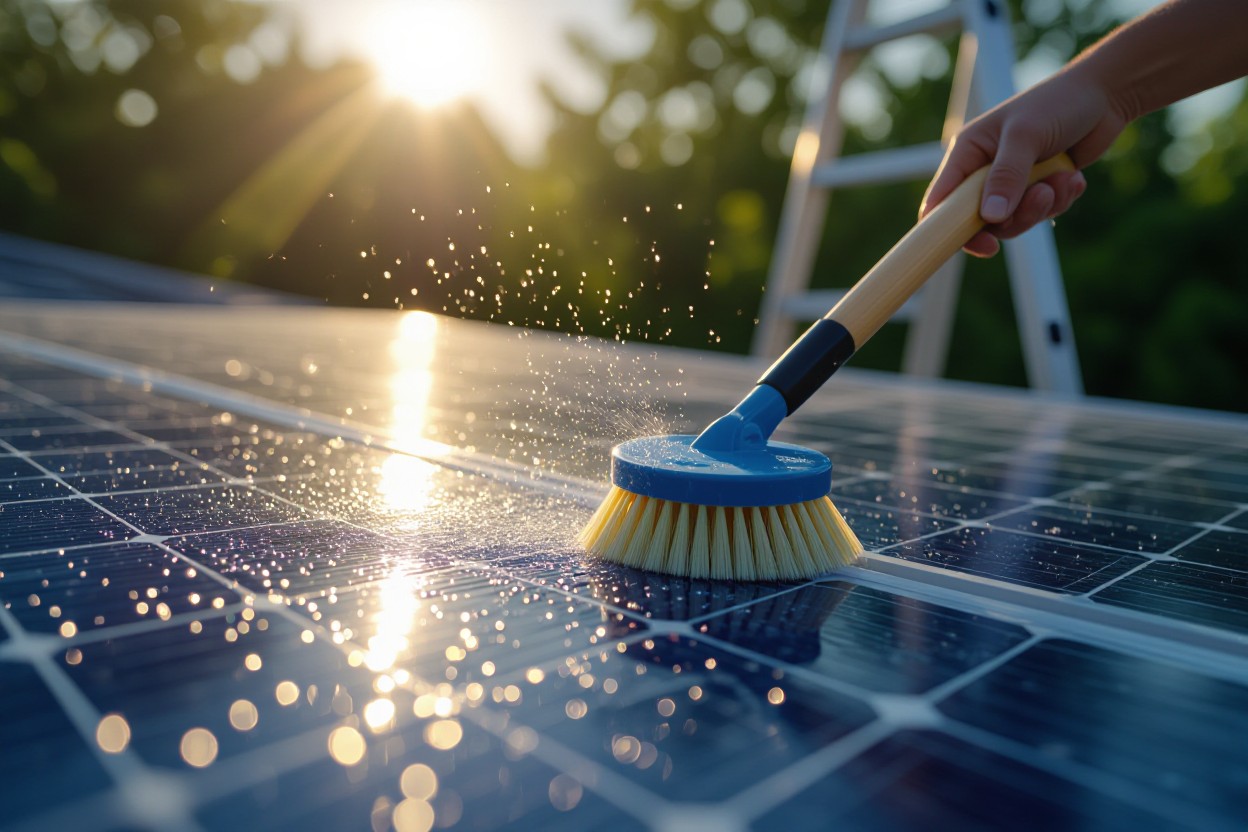
- Use a soft‑nylon bristle brush on an insulated telescoping pole to reach panels safely and avoid scratches.
- Use pH‑neutral, low‑foaming, solar‑safe cleaners; avoid ammonia, bleach, and abrasive products that can damage coatings or void warranties.
- Apply compatible hydrophobic or anti‑soiling coatings per manufacturer instructions to extend time between cleanings and protect surfaces.
- Clean in cool, low‑sunlight conditions, rinse thoroughly, and inspect seals, frames, and mounts while servicing panels.
The Unsung Importance of Clean Solar Panels
Soiling can shave off 5–25% of your panels’ output depending on location and season; dusty inland sites commonly see 10–15% losses while desert or pollen-prone areas can hit the higher end. You preserve both short-term yield and long-term warranty standing by using de-ionized water to rinse—minerals in tap water leave micro-deposits that act like permanent shading and accelerate soiling.
Physical maintenance choices directly affect durability: a water-fed telescoping pole with soft nylon bristles avoids micro-scratching, and pairing that hardware with a pH-neutral, non-ionic cleaning solution prevents film buildup that attracts dirt. Those small investments lower the frequency of cleanings and reduce the risk of hot spots or irreversible surface damage that would otherwise shorten panel life.
Impact on Efficiency and Energy Output
Performance losses are measurable: a 6 kW system producing roughly 7,200 kWh/year (about 1,200 kWh/kW-year in sunny regions) can lose ~10% from routine soiling—about 720 kWh or ~$108/year at $0.15/kWh. You reclaim that production by removing particulate layers and oily films; de-ionized water prevents streaks that would otherwise reintroduce diffuse shading, and soft-bristle brushing dislodges baked-on dust without scratching the anti-reflective coating.
Localized shading from bird droppings or tree sap can create hot spots that reduce module efficiency more than uniform dust layers do; targeted cleaning with a water-fed pole and spot treatment with mild, biodegradable cleaners restores output more quickly than generalized rinsing. Field tests show immediate power recovery after proper washes, often within a single sunny day, demonstrating how cleaning directly translates to measurable kWh gains.
The Cost-Benefit Analysis of Regular Maintenance
Professional residential cleanings typically cost $3–$8 per panel or $100–$300 per site per visit depending on access and system size; doing it yourself requires investing in a water-fed pole (~$150–$400) and de-ionized water or a DI filter system. If your cleaning restores 10% of output on a 6 kW system, you recoup roughly $108/year at $0.15/kWh—so a $150 paid cleaning offers a payback in about 1–1.5 years when performed annually.
Frequency drives economics: in suburban areas one annual cleaning may suffice, while dusty or agricultural regions justify quarterly visits. Applying a light, approved non-ionic protective treatment after cleaning can extend the interval between services—field reports suggest customers often stretch from four visits to three per year when combining DI water rinses with pH-neutral maintenance solutions.
For a concrete example, a rooftop 6 kW array losing 12% to soiling (≈864 kWh/year) costs you about $130/year at $0.15/kWh; spending $200 on a thorough cleaning that uses de-ionized water, a soft-bristle telescoping pole, and a pH-neutral cleaner returns that value within two years and reduces the likelihood of faster panel degradation and warranty disputes.
Essential Tools and Materials for the Task
Stock the job with a water-fed pole system that accepts de-ionized (DI) water, a soft-bristled brush head (nylon or lambswool), a supply of DI water (either portable tanks or on-board cartridges), and a handheld conductivity meter to verify water quality. Add a few microfiber towels and a squeegee for edge work, a mild pH-neutral, non-ionic solar-safe cleaner for oily deposits, and basic PPE: harness, non-slip boots, and eye protection. For capacity planning, expect a medium-sized residential array (10–20 panels) to require roughly 20–60 liters of DI water depending on soiling; plan cartridge change intervals based on local water hardness and throughput.
The Role of De-ionized Water in Solar Panel Cleaning
De-ionized water prevents mineral spotting and film that tap water leaves behind by removing dissolved salts and minerals; aim for DI water with resistivity above 1 MΩ·cm (conductivity below 1 µS/cm), with lab-grade ~18 MΩ·cm being ideal for spot-free drying. Delivering DI through a flow-through brush minimizes post-rinse streaks on tempered glass and anti-reflective coatings, so you avoid repeat visits in hard-water areas where tap water TDS can exceed 200–500 ppm.
On-site DI production usually combines reverse osmosis and mixed-bed resin cartridges or portable DI tanks; cartridge life varies widely—typical service ranges from 1,000 to 5,000 liters per cartridge depending on incoming hardness—so track conductivity readings and swap cartridges when readings rise above your target. For greasy or bird-drop deposits, pre-wetting with a 1–2% non-ionic surfactant cleaner followed by a DI rinse gives the best result without leaving residues that shorten the clean interval.
Choosing the Right Pole and Brush: A Guide to Effectiveness
Telescope poles made from carbon fiber give reach (4–12 m) with low weight and less torque than aluminum—expect a 30–50% weight reduction on long extensions, which reduces operator fatigue and sway. Select a flow-through brush head with a swivel joint to follow panel pitch; brush widths of 8–14 inches balance coverage and maneuverability. Use soft nylon or lambswool bristles to protect glass and anti-reflective coatings; avoid wire or stiff polypropylene that can micro-scratch surfaces.
Match brush stiffness to the job: dry dust and pollen clean with very soft bristles, while compacted grime or pollen cakes respond better to medium-soft density; apply light, consistent pressure (roughly 1–3 kg downward force) and let DI water and the brush do the work rather than scrubbing hard. Maintain the pole by flushing the feed lines after each use, inspect quick-release heads and seals monthly, and replace brush heads when bristles splay—typically after several hundred hours of use depending on soil type and frequency.
The Science Behind Cleaning Agents
Selecting Chemicals that Protect Your Investment
Choose pH‑neutral, non‑ionic surfactant cleaners formulated for architectural glass or solar modules; these typically have a pH around 7 and avoid stripping anti‑reflective coatings or sealants. A practical mix is de‑ionized (DI) water (resistivity near 18 MΩ·cm) with 1–3 mL of a mild, non‑ionic detergent per liter—enough to lower surface tension and lift oils without leaving ionic residues that cause spotting. Avoid ammonia, strong alkalis, bleach, or abrasive powders, since these can etch glass or degrade encapsulants and frame finishes over repeated use.
Look for products that list corrosion inhibitors and are recommended by panel manufacturers; third‑party tests show manufacturer‑approved neutral cleaners produce no measurable loss in optical transmission after hundreds of cleaning cycles. If you use a concentrate, follow label dilution and run a small patch test on an inconspicuous panel to verify no haze or coating change before treating the full array.
Enhancing Longevity: How the Right Cleaners Make a Difference
Removing particulate, pollen, and biofilms with DI water and a soft nylon brush reduces micro‑abrasions that accelerate coating wear, so you preserve peak transmittance longer. DI water prevents mineral redeposition—tap water can leave salts that increase soiling adhesion and reduce output by 5–20% in dusty regions; using DI water in a water‑fed pole system has been shown in field practice to restore more of that lost yield and keep panels cleaner between visits.
Chemical formulations that balance surfactants with temporary hydrophobic agents can extend the interval between cleanings: silane‑ or polymer‑based additives form ultra‑thin films that lower surface energy and shed dust for weeks to months depending on site conditions. Test any hydrophobic additive first, since excessive buildup or incompatible chemistries can alter anti‑reflective performance or complicate future maintenance.
Pairing the right cleaner with the correct pole and soft‑bristle brush matters: a carbon‑fiber telescopic pole feeding DI water to a soft nylon brush lets you apply the cleaning solution, agitate gently, and rinse without applying pressure that could scratch glass—this combination minimizes repeat cleanings and protects warranty‑covered coatings over the long term.
Step-by-Step Cleaning Methodology
| Step | Key Actions & Details |
|---|---|
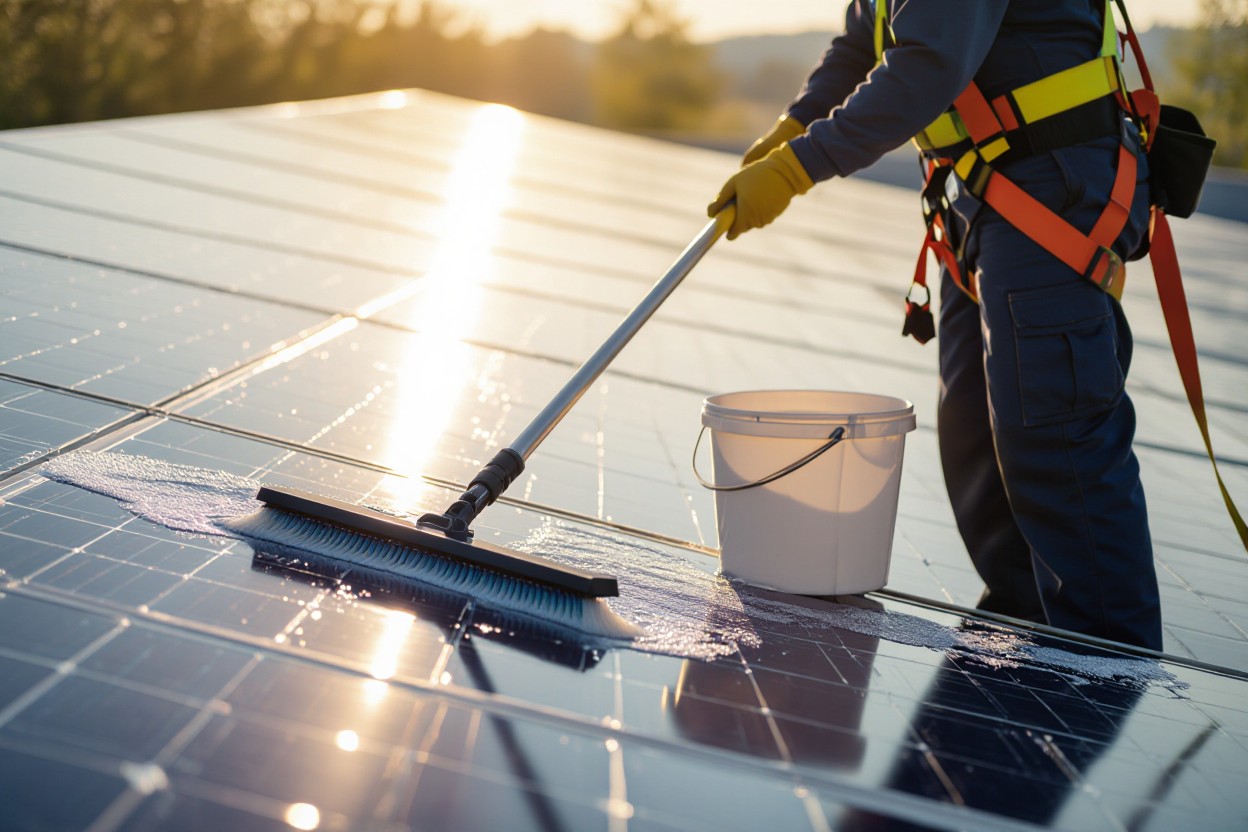
| Preparing the area & safety | Shut down or isolate the string per manufacturer instructions, secure ladder and anchor points, use a harness and non-conductive gloves, pick a cool, windless time (early morning or late afternoon). Set up a de‑ionized water supply (cart or hose-fed deionizer) and a telescopic pole sized to reach your roof—10–20 ft for single‑story, 20–40 ft for two‑story. |
| Correct technique | Pre‑wet panels with de‑ionized water, apply a pH‑neutral, non‑ionic cleaner diluted per label (commonly 0.5–1%), scrub with a soft nylon or microfiber‑sleeved brush on a swivel head using straight strokes, then rinse thoroughly with de‑ionized water and squeegee excess. Avoid high‑pressure washers and abrasive bristles; inspect seals and glass for damage after cleaning. |
Preparing the Area and Ensuring Safety
Turn off the inverter or isolate the array according to the system manual before stepping onto the roof; arcs and live conductors become a hazard when panels are wet. Secure fall‑arrest anchors and use a harness with a lanyard rated for your roof height, have a ground spotter to steady ladders, and confirm weather conditions—no cleaning during winds above 15 mph or direct midday sun that raises module temperature by 20–30°C and risks thermal shock.
Set up a de‑ionized water source sized for the job: a 50–100 L cart for small residential arrays or a hose‑fed deionizer for larger systems so you avoid mineral spotting. Choose a telescopic pole that reaches panels without overextending; a 12–18 ft pole covers most single‑story roofs and keeps you off fragile areas. Wear rubber‑soled shoes and non‑conductive gloves, and always inspect the roof surface for loose tiles or debris before placing weight on it.
The Correct Technique for Optimal Results
Begin by flooding the module with de‑ionized water to soften grime, then apply a diluted pH‑neutral, non‑ionic cleaner (typical dilution 0.5–1% unless the product states otherwise). Use a soft nylon brush or microfiber sleeve on a swivel telescopic head, working in straight strokes parallel or perpendicular to cell lines to lift deposits; apply light, even pressure—enough to remove bird droppings and pollen but not to scour the glass or frame seals. Rinse immediately with de‑ionized water to avoid re‑deposition of loosened particles.
Finish with a full de‑ionized rinse and a microfiber squeegee or wipe to remove residual water and prevent streaks; panels cleaned this way typically take 5–10 minutes each for a 1.6–2.0 m² module. If you use a polymer hydrophobic protectant, apply it per the manufacturer—many products extend time between cleanings by 3–6 months and can reduce re‑soiling rates by up to 30–50% in coastal or dusty environments. Avoid pressure washers and abrasive bristles that can damage anti‑reflective coatings and frame seals.
Choose pole systems with replaceable microfiber sleeves and a swivel head to maintain correct brush angle on tilted arrays; replace sleeves after 10–20 panels or sooner if they pick up grit. In comparative field trials, rinsing with tap water left visible mineral streaks on 15–25% of panels, whereas de‑ionized final rinses produced consistent, spot‑free results—so prioritize de‑ionized water for the final rinse and for sensitive sites like coastal or hard‑water regions.
Common Pitfalls and How to Avoid Them
Mistakes that Can Damage Your Panels
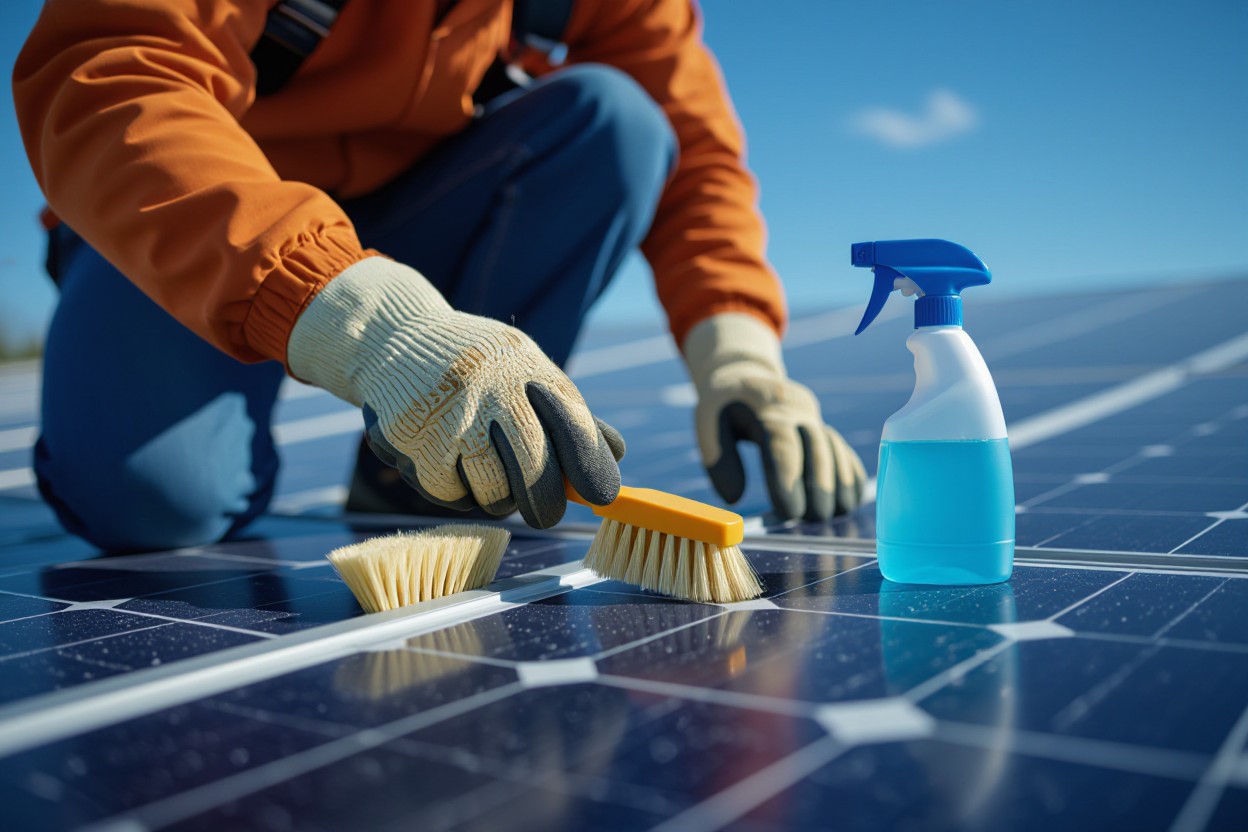
Hard or mineral-heavy tap water leaves calcium and magnesium deposits that create micro-lenses on the glass, cutting output over time; use de-ionized water (aim for conductivity under 10 µS/cm) to avoid spotting and streaks. Scrubbing with metal or stiff-bristle brushes will abrade the anti-reflective coating—choose a soft nylon-bristle brush and a non-metallic extendable pole so you can clean from the ground or eaves without stepping on the array. Typical pole lengths of 4–6 m let you reach most residential roofs safely.
High-pressure washers and narrow nozzles concentrate force and can break seals or crack glass—avoid pressure settings above about 1,000 psi and never use a 0–15° jet on panels. Strong alkaline or solvent-based cleaners (ammonia, bleach, acetone) strip coatings and may void warranties; instead use pH-neutral detergents or manufacturer-approved solutions. Also avoid walking on panels—microcracks from foot traffic are a common warranty-excluding cause of long-term performance loss.
Maintaining a Regular Cleaning Schedule: A Key to Success
Establish a cadence based on local conditions: every 6–12 months for suburban sites, every 3 months in dusty, agricultural, or coastal areas, and immediately after heavy pollen events or construction dust. Track your system’s production with monitoring software—if energy falls roughly 3–5% below expected output on clear days, inspect and clean your panels. When you clean, work in the cool hours (early morning or late afternoon) to avoid thermal shock, use de-ionized water and a soft-bristle brush on an extendable pole, and apply a diluted pH-neutral cleaner or an approved hydrophobic solution to help soils shed and extend time between visits.
Automated options can pay off for hard-to-access arrays: robotic cleaners that use de-ionized water and soft brushes typically cost in the low thousands but can maintain peak output without roof access. Set calendar reminders tied to seasonal risk (spring pollen, autumn harvest) and check performance after storms; a quick visual check or a data-triggered inspection will keep soiling losses from becoming permanent production declines.
To wrap up
To wrap up, you should use de-ionized water to rinse and wash your panels to prevent mineral deposits and streaking, pair it with the right extension pole and a soft-bristle brush so you can clean safely without scratching, and select mild, pH-neutral cleaners or manufacturer-approved protective treatments to protect surfaces and extend the period between cleanings.
When you combine de-ionized water, the proper pole and bristles, and appropriate, panel-safe chemicals applied per instructions, you preserve output and avoid damage; perform cleaning during cool, low-sun periods and work top-down while following your panel manufacturer’s guidance to keep your system efficient and protected over time.
FAQ
Q: Why use de-ionized water to clean solar panels?
A: De-ionized water has had minerals and dissolved salts removed, so it won’t leave spotting or conductive residues on glass or frames. That reduces corrosion risk and maintains electrical performance. It rinses away dust and detergents cleanly, so less streaking and no mineral buildup that attracts grime.
Q: What is the correct pole and bristle setup for cleaning?
A: Use a non-conductive telescoping water-fed pole (fiberglass or carbon-fiber) sized so you can clean from the ground where possible. Fit a soft, non-abrasive nylon brush head or microfibre brush—preferably with an angled or swivel head for panel tilt. Avoid metal or stiff wire bristles and heavy scraping motions that can scratch glass or damage seals. For best results use a water-fed pole that supplies de-ionized water to the brush head.
Q: Which chemicals are safe and effective to protect panels and extend clean intervals?
A: Choose pH-neutral, non-abrasive, biodegradable cleaning agents specifically formulated for glass or solar panels; dilute per manufacturer instructions and rinse thoroughly with de-ionized water. Do not use bleach, strong acids, ammonia, or abrasive powders. For longer-lasting cleanliness, consider manufacturer-approved hydrophobic or anti-soiling coatings; apply only according to product instructions and test on a small area first. Reapply coatings as recommended (often 6–18 months depending on product and environment).
Q: What is the step-by-step correct cleaning method?
A: Work when panels are cool (early morning or late afternoon) and weather is calm. 1) If possible clean from the ground with a water-fed pole; otherwise use fall protection. 2) Rinse panels with de-ionized water to remove loose debris. 3) Apply a small amount of pH-neutral detergent if needed, agitate gently with the soft brush in straight top-to-bottom strokes. 4) Rinse thoroughly with de-ionized water to flush all soap. 5) Remove excess water with a soft squeegee or allow to air-dry to avoid streaks. Inspect for missed spots and repeat only where required.
Q: How often should panels be cleaned, and what safety precautions apply?
A: Cleaning frequency depends on location and soiling: typically every 6–12 months in most areas; more often in dusty, coastal, or agricultural settings or after heavy pollen or bird-dropping events. Always follow these safety rules: avoid roof work unless trained and using fall protection; never stand on panels; isolate or follow the inverter/manufacturer shutdown guidance if required; avoid cleaning in wet, icy, or windy conditions; hire professional cleaners for steep, high, or complex arrays.